When a buyer in Chugiak, Birchwood or Peters Creek asks who plows the road in front of the house, there are three possible answers. The Municipality's contractor plows it on a set trigger. The neighbors pay for it themselves. Or nobody is responsible for it. A road's appearance in October won't tell you which answer applies. Its acceptance history and the documents recorded against it will.
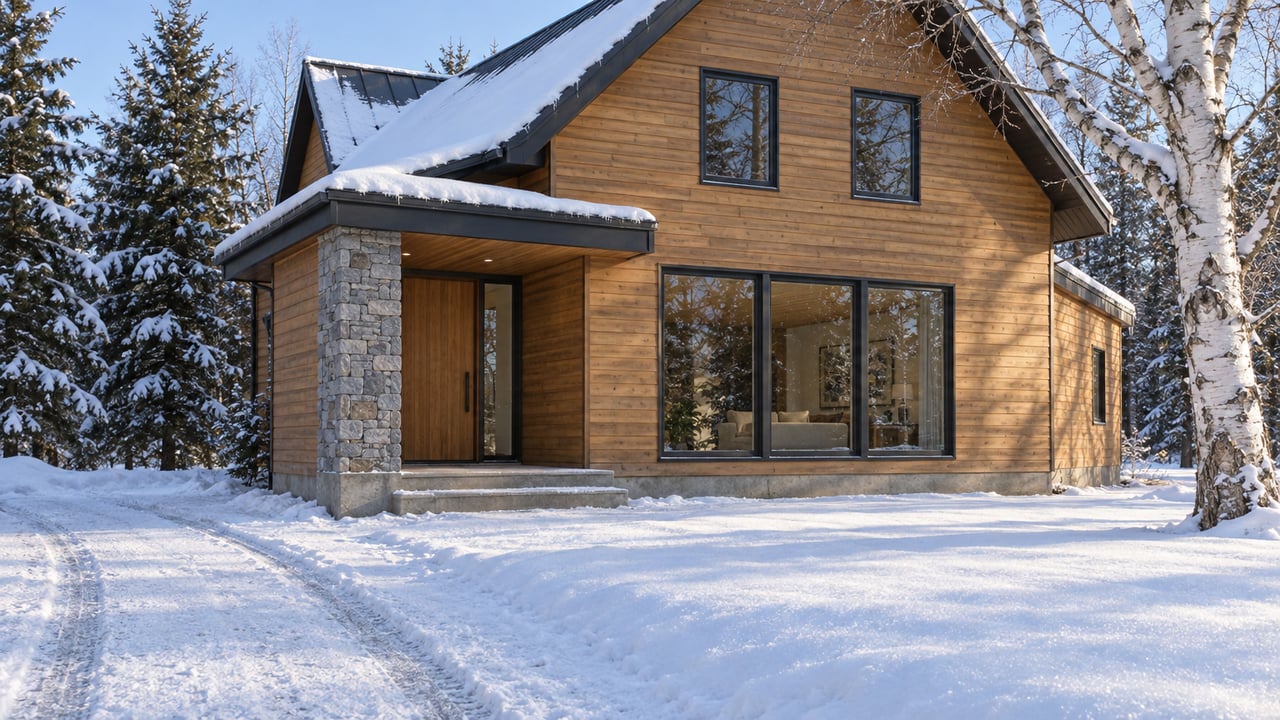
Last year, the first major snowfall reached Southcentral on a Thursday in early November, Alaska's News Source reported. Midtown Anchorage had nearly 4 inches by 5 p.m., and the Glenn Highway was closed for several hours after two crashes. On a Chugiak side street, 4 inches is the exact amount that starts the plowing clock. That's why the question matters most for anyone closing on a rural home this season.
The plowing rules depend on what kind of road you're on
The Chugiak-Birchwood-Eagle River Rural Road Service Area, known as CBERRRSA, covers more than 350 lane miles across Chugiak, Birchwood and Eagle River. Voters created it by merging the earlier separate rural road service areas in the October 1984 election, and it was formed in 1985. Private contractors do the work, scheduled and directed by Municipality of Anchorage staff.
The service area's published standard has three levels:
- Main and collector routes. Plows go out shortly after 2 inches or more of snow has built up and keep working until the snow stops.
- Side streets. These are plowed only after 4 inches or more has built up, and they are to be finished within 24 hours of the contract equipment being dispatched.
- Driveway and mailbox berms. Under a Road Board policy, clearing these is entirely the property owner's job, including the berm the plow leaves at the end of the driveway.
There is also a fourth case that the service area page doesn't list. The Municipality's Road Maintenance Service Area Program document says plainly that if a rural road has not been accepted by the Municipality, the road service area provides no maintenance on it. For any particular address, the answer turns on whether its road was accepted, and being inside the service area boundary is only the first step.
Why some Chugiak roads were never accepted
The same document explains how this happened. Many rural roads were built to lower standards, without enough right-of-way, before their service areas existed and before road standards were in place. Many of these older roads "are not accepted, do not have adequate right-of-way and are not readily maintainable," and the Municipality decides on a case-by-case basis whether it can maintain them and how much. A few get limited maintenance when that has been the historical practice and residents and emergency vehicles need the access. Even then, the service area does nothing beyond what safe access requires.
Road service areas also aren't required to bring those roads up to standard. For a road to qualify, the Municipality's basic guidelines call for:
- A right-of-way at least 60 feet wide, which can be reduced to 50 feet if there is a 5-foot snow-storage easement on each side
- A driving surface at least 20 feet wide with a 2% crown
- Drainage ditches on both sides with 2-to-1 slopes
- Enough strength to safely carry an 80,000-pound fire truck
When a road can't meet those criteria, the Municipality says residents "will need to establish a homeowners association or group to fund road maintenance services for your area." That sentence explains a lot about how houses on narrow, older Chugiak roads change hands. Once you buy, the neighbors' plowing arrangement becomes your arrangement too.
The tax bill shows what the service area costs, not what your road gets
CBERRRSA's 2026 approved budget lists $9,901,445 in function costs. The Municipality's 2026 tax-rate ordinance sets the service area's levy at 2.10 mills. The Municipality's guidance explains that one mill is $1 for every $1,000 of assessed value. At that rate, a home assessed at $400,000 would carry about $840 a year for road service.
The service area is also busy with the roads it already maintains. On June 23, 2026, the Anchorage Assembly approved a recommendation to award McKenna Brothers Paving Inc. an indefinite-quantity CBERRRSA road maintenance contract, ITB 2026B042, capped at $10,873,990 per contract year. The Road Board's September 28, 2026 agenda still listed "Road Maintenance Contract" under old business, along with "Harry McDonald Road – Conditional Acceptance" and an "Aurora Borealis – Status" item. The Harry McDonald item shows that acceptance can still be pending in 2026. The agenda doesn't say how it was decided.
The five-member Road Board has one member nominated by each of the Eagle River, Eagle River Valley, Southfork, Birchwood and Chugiak community councils. It advises the Municipality and reviews budgets, service levels and capital priorities. Its meetings are where a road's status gets discussed in public.
A neighborhood plowing its own streets
Eaglewood Subdivision in Eagle River, inside the same service area, shows what a funded private arrangement can look like. According to its homeowners association, Eaglewood owns its own streets, street lights, sidewalks, paved and lighted trails, and common areas. Its snow management rules, adopted February 5, 2026, say its contractor normally starts within 24 hours after 2 to 4 inches of snow. Major and feeder streets come first, then the subdivision's 56 or more circles, which are to be cleared within 72 hours after the snow stops. As under CBERRRSA, residents clear their own berms.
That's the well-organized version. On a smaller private road in Chugiak or Birchwood, the arrangement may be a group of neighbors and a contractor they hire. Chugiak-based Snowman LLC advertises driveway plowing and sanding by the push, by the month, by the season or for special events. Northern Snow Removal lists Chugiak and Peters Creek in its service area. Both price by quote and don't post rates. So the real cost of an unaccepted road depends on whatever agreement the current owners already have.
Where this comes up before closing
Most of the trouble starts in underwriting. Each major loan program handles a privately maintained road differently, and each rule below is quoted from the program's own guidance.
| Loan program | What the guidance says about private roads |
|---|---|
| Conventional, Fannie Mae | Requires a recorded, legally enforceable maintenance agreement or covenant that sets out cost shares, default remedies and a term, usually permanent |
| VA | Requires a recorded permanent easement or right-of-way to a public road. The joint maintenance agreement requirement was dropped in 2022 |
| USDA guaranteed | Requires a permanent recorded easement to a public street or HOA maintenance, plus a hard or all-weather surface |
Fannie Mae's Selling Guide section B4-1.3-04 says:
"If the property is located on a community-owned or privately-owned and maintained street, an adequate, legally enforceable agreement or covenant for maintenance of the street is required."
The guide adds that if the agreement is missing or falls short, and the state has no law setting out owners' maintenance duties, the lender may still sell the loan but must indemnify Fannie Mae against losses tied to the street's condition or to access. That indemnity puts the risk on the lender, so the lender has every reason to ask for the documents early.
VA Circular 26-22-17, issued November 25, 2022 and in effect until rescinded, ended the requirement for an HOA or joint maintenance agreement on properties served by private roads and shared driveways. A recorded permanent easement or right-of-way from the property to a public road must still be in the loan file. USDA's HB-1-3555, section 12.7, accepts private roads protected by a permanent recorded easement or maintained by an HOA. The road must also let emergency and ordinary passenger vehicles get through at all times. USDA eligibility is checked one address at a time.
On the seller's side, Alaska's Residential Real Property Transfer Disclosure Statement asks whether road maintenance is provided and, if it is, who provides it. The form also asks about any HOA, including its name, status and dues, and lists written agreements with neighboring owners among the documents a seller may have available. The form says sellers generally must deliver it before the buyer makes a written offer, with some stated exceptions. For a Chugiak seller on an unaccepted road, the recorded agreement and a clear disclosure answer handle the same issue the buyer's lender will raise anyway.
This post is general information, not legal, tax or financial advice. Please confirm your own situation with your lender, attorney or title professional.
When a road qualifies but isn't served
A road that meets the criteria can be added through a process with a set timeline. Residents ask the Municipality's coordinator for a qualifying petition and collect neighbors' signatures. After review, the Assembly must receive the ballot ordinance by its first regular meeting in January so the question can go on the April municipal ballot. Adding an area to an existing service area takes a majority in the existing area and a separate majority in the area being added. If voters approve, service starts either the following January 1 or, under a retroactive measure, on May 1 of that year. Either way, a buyer closing this fall would get through at least one winter under whatever arrangement the road already has.
A few direct questions
How do I find out who maintains a specific Chugiak road? Look up the address on the Municipality's street ownership and maintenance map, which separates state, service area and private routes. You can also call the CBERRRSA office at the Eagle River Town Center, 907-343-1510.
Does the plow clear my driveway? No. Under CBERRRSA policy, owners clear their own driveway and mailbox berms.
Who handles complaints about service on a maintained road? The Road Board sets service levels and meets in public at the Eagle River Town Center, 12001 Business Boulevard.
Before you write an offer on a rural Chugiak, Birchwood or Peters Creek home, or list one, the Mehner Weiser Real Estate Group team can help you find out early who maintains the road, what has been recorded and what the lender will ask for, so the answer doesn't arrive with the first snow. We Welcome You Home. Schedule a consultation.