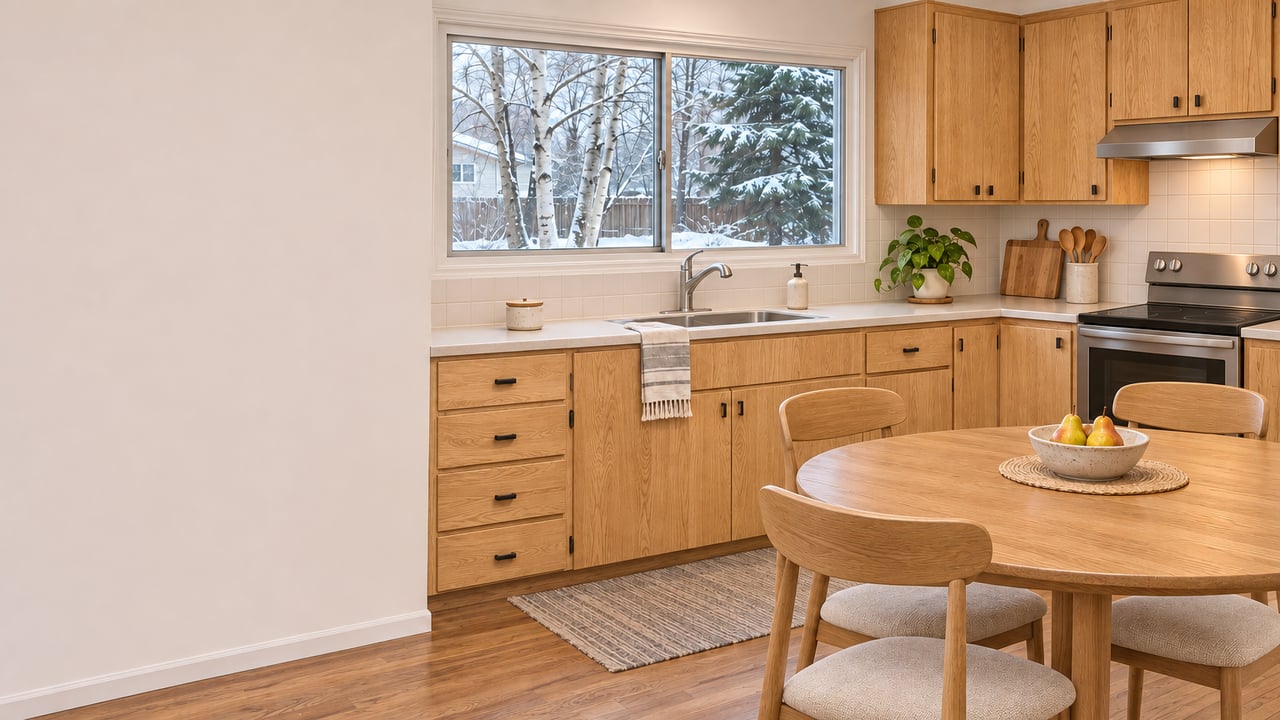
This past summer a three-bedroom, one-bathroom house in Nunaka Valley came on the market. The owners had done most of the renovations themselves, and the yard was fenced. In its first weekend it drew five offers, and some came in over the asking price. The Anchorage Daily News reported that the listing broker called it "nothing really special."
About a month later the same paper reported that the Municipality of Anchorage had issued about 530 residential building permits by the end of October 2026. That is the most in ten years, and the first time the city has passed 500 since 2015. If you're planning a purchase, the obvious hope is that more building means less competition for houses like the one in Nunaka Valley. The permits say otherwise. Most of this year's construction is rentals, senior housing and renovations. The house most Anchorage buyers will compete for over the next few years already exists, and it was probably built around 1980.
Where the 530 permits went
Multifamily units account for more than half of the 2026 permits, according to ADN's Nov. 14 report. City officials and developers credit a tax break for larger housing projects that the Assembly approved in 2025. Between 2024 and 2026, the number of multifamily projects underway with five or more units went from 34 to just over 300.
Here are the named projects in that count:
- Raspberry Townhomes, Sand Lake. Developer Shaun Debenham broke ground this spring on one- and two-bedroom rentals priced at $2,400 to $2,800 a month. The units won't be ready to move into until next year.
- Block 96, Downtown. Debenham's recently finished downtown building rents for $1,750 to $2,600 a month, including utilities and parking. He told ADN every unit is rented.
- The Nest at Baxter Road, East Anchorage. Cook Inlet Housing Authority finished Phase I at the end of October. It had 225 rental applications for 24 apartments.
- Touchmark at Hillside, South Anchorage. This planned retirement community alone accounts for 120 of this year's permits. Its own timeline puts the opening in 2029.
None of these four is a home you can buy. All of them still matter to a buyer. New rentals give some households a place to live while they save, and Touchmark could eventually give some longtime Hillside owners a reason to sell. That takes years, though. Touchmark's 120 units won't open until 2029, and Raspberry Townhomes won't be ready until next year. Block 96 is fully rented, and most of The Nest's first apartments are already full. Nothing on this list adds a house for sale this winter.
New homes for sale inside the city sit at the low and high ends of the price range
There is new for-sale construction inside the Municipality, and ADN photographed homes going up in the Westpark neighborhood near Sand Lake on Oct. 7.
In Northeast Anchorage near the Glenn Highway and Turpin Street, Spinell Homes is building Birch Meadow, a single-family community on Takotna Loop. Spinell's Birch Meadow page currently lists a starting price of $458,000, with build plans at $515,000 and $563,000.
On the South Anchorage hillside the numbers move up. At Fern Hollow, on Miranda Drive, Spinell lists 21 available lots and build plans from $662,000 to $730,500. Above Golden View Drive, the Spruce Terraces plans run from $933,500 to $1,093,000 for four-bedroom designs.
Now compare that to the market as a whole. An Anchorage Economic Development Corp. report put the average Anchorage home at $481,000 in 2026, up 42% over the past decade, as ADN reported in September. Birch Meadow's starting price is a little under that average. Everything else above is well over it. The buyers who had the hardest time this year were shopping at roughly $375,000 and below, which is where ADN's reporting placed the entry-level market, and none of the new communities above is priced there.
Cost explains much of this. Debenham told ADN that building in Anchorage costs about 15% to 20% more than in Mat-Su, and he pointed to the city's land use code and Alaska's short building season. When a new house costs that much to build, a builder has two realistic options. One is a tract where land and plans keep the price down, as at Birch Meadow. The other is a view lot on the Hillside, where buyers will pay for the setting.
The house most buyers compare is still from around 1980
Hannah Hennighausen, an associate professor of economics at UAA's Institute of Social and Economic Research, gave ADN a number that sums up the market. In 2000, the median build year of homes sold in Anchorage was 1980. It still is today. For 26 years, the typical house changing hands in this city has had the same birth year, while getting older every year.
The city's own housing staff describe the same situation. Graham Downey, the Municipality's deputy director of community and economic development, told ADN that much of Anchorage's housing was built in a hurry around 1970 and 1980 and needs repairs or renovation. He also said rehabilitation is almost always cheaper than building new. Alongside the 530 new-build permits, the city counted more than 600 major home and apartment renovations and rehabs permitted in 2026.
Mayor Suzanne LaFrance's housing math works the same way. She estimates Anchorage needs about 11,800 units over the next decade. About 3,100 of those are new builds, and about 8,700 are renovated or replaced homes. In the mayor's estimate, nearly three of every four homes Anchorage needs are renovated or replaced homes rather than new builds.
For a buyer, this changes how to read a listing. Two 1980 split-levels on the same street can be very different houses, depending on whether the roof, windows, heating system and kitchen were replaced in the last ten years or in the year the house was built. When nearly every house you tour is about the same age, the age tells you little. The condition and the work history set the price. The Nunaka Valley house had no special features, but it looked finished at an entry-level price, and it drew five offers. Hennighausen also told ADN that a starter home 30 years ago could have been a 1,200-square-foot house in Midtown, while today it is more often a townhouse or condo. Buyers comparing those options downtown will find more in our post on Downtown condo pricing.
Demand that comes before the new apartments are finished
The permit surge is also running into a deadline. Joint Base Elmendorf-Richardson's Fightertown Recapitalization program is projected to bring about 2,500 new service members plus their households. Junior personnel are expected to live in on-base barracks and dorms, and the rest will look for housing off base, according to ADN's Sept. 27 report on Assembly budget discussions. Figures JBER gave the Municipality show Anchorage would need an additional 1,200 two-bedroom units, 650 three-bedroom homes and 645 homes with four or more bedrooms by 2030.
Raspberry Townhomes, the one named rental project still under construction, is one- and two-bedroom units, which matches the first of those categories. The 1,295 homes with three or more bedrooms are a separate need, and unless more of that size gets built, those households will be shopping the same resale market as everyone else. Municipal policy director Nolan Klouda told the Assembly that a base expansion normally relies on the private market to supply housing. He added, "we have an environment where a lot of housing doesn't pencil out financially."
A few questions buyers ask about the building boom
Will all the new construction bring Anchorage home prices down soon? The 2026 permit count mostly adds rentals, a retirement community and renovations. Raspberry Townhomes opens next year and Touchmark in 2029, so neither changes the number of houses for sale this winter. Through 2030, JBER's projected need for family-sized homes adds to demand.
Is new construction an option if I want to stay inside the Municipality? Yes, though most of it is at the low and high ends of the price range. Birch Meadow in Northeast Anchorage starts below the 2026 average price. Fern Hollow and Spruce Terraces on the South Anchorage hillside are priced well above it. If the Hillside is your goal, our South Anchorage and Hillside neighborhood page covers the area.
If I already own a 1980 house, does any of this affect me? It probably affects you more than anyone else. Your house is the kind most buyers will be choosing from, and the updates you've made are a big part of how it gets priced against the houses around it. An updated home valuation is a practical starting point.
At Mehner Weiser Real Estate Group, we work with buyers and sellers across Anchorage, from Northeast Anchorage to the Hillside. If you're comparing a new build with an older house that's been well kept, or you want to know how your own updates stack up before you list, we'd be glad to go through the numbers with you. We Welcome You Home. Schedule a consultation.